There is an interesting statement from economist Raden Pardede after two years of the Joko Widodo-Ma’ruf Amin government running. He said, the COVID-19 pandemic has made this government lose two years of opportunity to leave a legacy. To make up for the lost two years, there is no other choice for the remaining three years, development must be driven with an average growth rate of above six percent.
How then? Indonesia can no longer carry out development as they did yesterday. Indonesia can no longer do business as usual. Indonesia have to make a major transformation. All sectors must be encouraged to be able to provide high added value.
This is the point of the problem that must be solved. Thinking out of the box must be applicable. This is because growth of above six percent can only be done if there is a huge investment that provide high added value. From this investment, it is hoped that job opportunities will be opened and from there, there will be an increase in Indonesian people’s purchasing power.
The Indonesian economy so far has relied heavily on public consumption and investment. Of the two sectors, the contribution to gross domestic product is above 70 percent. The government stimulus that became the foundation during the COVID-19 pandemic only contributed about 10 percent to growth.
In this second term of government, President Jokowi has made plans to encourage investment, including human investment. The job creation law was launched to facilitate the entry of investment. Simplifying licensing by combining more than 70 laws into one law is not an easy job in the midst of the strong sectoral ego. But that choice must be taken for the sake of the flow of investment to Indonesia.
The challenge now is how to implement the Job Creation Law. The devil is in details. Its implementation must go through other struggles because it is related to changes in work attitudes, related to changes in the mindset of many Indonesia ministries and of many Indonesia people.
Singapore can do it
With a population of around 270 million, abundant natural resources, a young and productive workforce, and a projection that it will become the fourth largest economic power in the world, Indonesia is attracting a lot of attention.
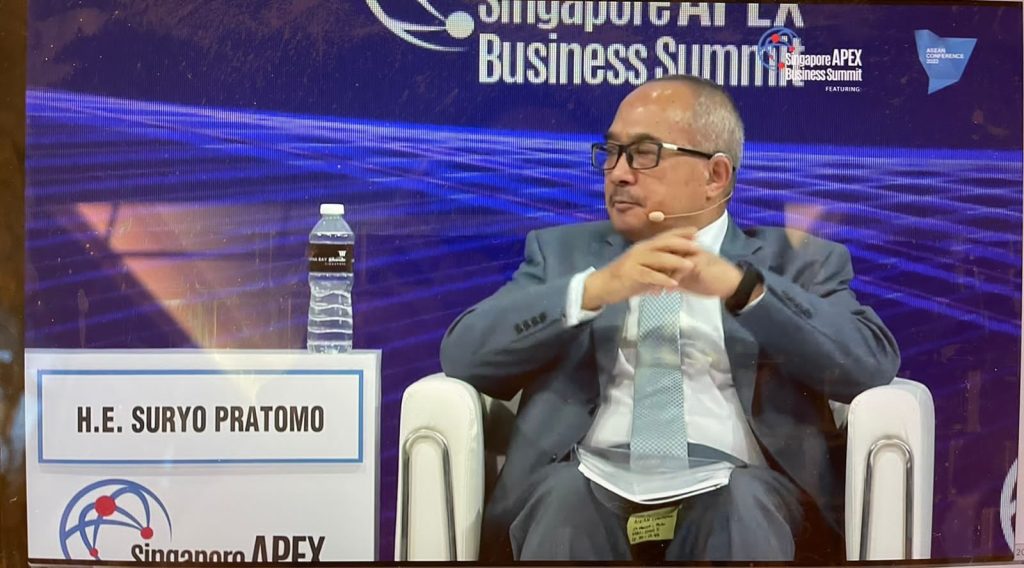
One year’s experience as the Indonesian Ambassador in Singapore can feel how much attention and interest the world community has for Indonesia. Facebook, Etisalat, HPL Group, YCH, InvestCorp, SembCorp, Pavilion Energy, Shopee, Sunseap just naming several corporations that willing to invest in Indonesia.
It’s all up to Indonesia now. How big is Indonesia desire and willingness to take advantage of all these opportunities? How big is Indonesia ability to be willing to change and be open to the entry of investment, especially those from abroad?
We have to be honest, that xenophobic attitude still exists among Indonesian. Suspicion of the entry of foreign investment is still high. As a result, the implementation of the Job Creation Law is not in line with Indonesia interest in inviting investment in.
President Jokowi is well aware of that fact. While giving briefings to the President Director of State-Owned Enterprises, the President complained about his efforts to open up the entry of investment, but it was not followed by the speed with which executions were carried out in the field. Even the President said he was ashamed to have offered Indonesia, but in the field it was difficult for investors to invest their capital.
Indonesia must be willing to reflect on other countries that are more open and friendly to the entry of foreign investment. One that can be a reference is Singapore. How can this city-state turn into a developed country and be able to prosper its people—with a per capita income of US$ 65.000—even though they don’t have many natural resources.
The key to their success lies in their open attitude and legal certainty. Almost all of the world’s major corporations have offices and investments in Singapore. Prime Minister of Singapore Lee Hsien Loong said the total US investment only in Singapore reached US$ 315 billion. US investment in Singapore is much larger than the combined total US investment in China, India and South Korea.
Let’s now look at the total foreign direct investment (FDI) that entered Indonesia last year. The largest came from Singapore, which was US$ 9.8 billion. That amount is a third of the total FDI invested in Indonesia. This means that the total incoming FDI in 2020 is around US$ 30 billion.
The question is, is the amount of FDI sufficient for Indonesia, which is so large and rich in natural resources? Of course we will say no. Indonesia should be bigger than that because the potential that Indonesia have is far greater than what has been realized.
Not too late
Of course, Indonesia don’t need to be discouraged. There is still a chance for Indonesia to improve their attitude and seize the opportunities that exist. Especially post-covid-19, when all countries and companies are trying to bounce back, making up for two years of lost opportunity.
As we know, the world is facing problems on the supply chain side. Economic recovery is constrained by the limited supply of both energy and products. In fact, the issue of energy becomes very serious because it will affects the production side.
China’s growth in the third quarter did not reach 4.5 percent (yoy), even though in the first two quarters of 2021 their economic growth shot up high. The limited electricity supply has made many factories reduce production and as a result, the Chinese economy will be depressed in the fourth quarter if they can’t solve their energy supply problems.
The same thing happened in European countries. The energy transition to create a greener world is not supported by alternative energy that is more available and affordable. As a result, European countries will not only have to face colder and darker winters, but there will also be disruptions on the production side.
Disrupted supply chains led to increased inflation in the UK and US. The goods needed by the community are not able to be fulfilled in sufficient quantities, thus making prices rise. In UK even people have to buy petrol in jerry cans because many cars run out of fuel in the middle of the road.
If Indonesia are smart, then Indonesia will be able to fill the void of goods needed by the world community. For example shoes. Nike’s three main producing countries are Indonesia, China, and Vietnam. Now that production in China is disrupted, it’s time for Indonesia to take China’s market share. It just need an upgrade of production line because Indonesia have skilled workforce and reliable Industry in this sector.
When US Vice President Kamala Harris visited Singapore, one issue that was raised was the supply chain side. Especially to meet the needs of semi-conductors for automotive companies. The US invites Singapore to work together to fill this need. Indonesia can be a part of this collaboration, because Singapore definitely needs a place and manpower for the semi-conductor industry.
There are so many opportunities, especially after the COVID-19 pandemic. All countries are increasingly opening their eyes that it is impossible to depend on only one country. So far, almost China is the only source of supply. When China was rocked by COVID-19, the entire world supply chain was disrupted.
Now what Indonesia need is to map the disruption that is happening and on which side Indonesia have the advantage. Indonesia optimize their advantage to become a real investment. Indonesia make it easy for all investors to enter the sector that believe will be Indonesia advantage.
The Job Creation Law already exists, now it just takes the will to give certainty to its implementation to investors. Indonesia really give them comfort to do business and don’t be bothered with long bureaucracy and high costs economy.
As President Jokowi said to the CEOs of SOEs, now speed in making decisions is very important. Of course it must be accompanied by professionalism so as not to be careless. If Indonesia can’t do it theirselves invite foreign company to be a partner. Once again, there are many who want to enter Indonesia, but often they are suspended for too long and are not given an answer, thus making investors confused. Actually, Indonesia is an investment destination or not?